The explosive growth of the West Valley is, in one way, good for downtown Phoenix. (And I'm not referring to the fact that the West Valley did downtown a favor by taking the Cardinals off our hands.)
The fact that the west side has grown so much means that at least geographically, downtown is now back as the center of the metro Phoenix area. Companies now have more of an incentive to locate in central and downtown Phoenix as their workforces now commute from both the east and west sides of town. And people living in downtown Phoenix can get to either side in a flash. I just got back from Tempe (Apache and McClintock) in 16 minutes. Believe it or not, it's 30-35 minutes to faraway Surprise from downtown.
Just one more reason why it's great to be downtown.
Sunday, January 28, 2007


Thursday, January 18, 2007
Downtown Phoenix updates

* New life is being breathed into vacant buildings at 841 N. Second Avenue (below), across the street at approximately 830 N. Second Avenue (below), and at the Professional Building at Central and Monroe (above) as downtown continues its comeback.
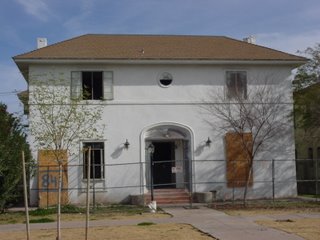
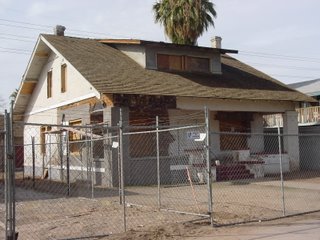
* "Matt's Little Tavern," a.k.a. The Roosevelt, is up and running to rave reviews. I've been there twice, and it's cool. It's housed in the 1909 Farish house, which gives the bar the feel of a house party. For better or worse, the place is packed-- with all types of people ranging from Brophy teachers to beatniks (I never knew Phoenix had so many). The beers are awesome and the food is creative, although it's strictly snack food and won't make it as a dinner. Feel free to show it off to your friends from the suburbs and other cities-- it doesn't disappoint.
* The Royal Coffee Bar has opened at Second Avenue and Jackson Street in the warehouse district. I'm not a coffee fan but the interior is distinctly urban. Next door is the Sweet Pea Bakery. Looking down Jackson Street are pluses and minuses as the Summit condo at 5th Street is nearly topped off, towering over the neighborhood, but The Old Brickhouse at Central Avenue has shut its doors.
Saturday, January 13, 2007
Now if only University of Phoenix Stadium could get this right...
I'm not crazy about the Diamondbacks new ownership and the pettiness that they displayed in getting rid of all remnants of the Colangelo regime (they even changed the team's colors). But these new guys could start to grow on me if they make sensible decisions like keeping the roof open during the nice weather.
I swore off going to D-Backs day games during nice weather two seasons ago when I wasted three hours on a gorgeous April afternoon sitting inside BOB with the roof shut. They even had the nerve to display the outside temperature-- 73 degrees!-- while we sat inside the sterile environment.
All this apparently because a few whiners couldn't stand the sun in their eyes. (Note to wimps: invest in sunglasses.)
I'm looking forward to baseball season already...
I swore off going to D-Backs day games during nice weather two seasons ago when I wasted three hours on a gorgeous April afternoon sitting inside BOB with the roof shut. They even had the nerve to display the outside temperature-- 73 degrees!-- while we sat inside the sterile environment.
All this apparently because a few whiners couldn't stand the sun in their eyes. (Note to wimps: invest in sunglasses.)
I'm looking forward to baseball season already...
Saturday, January 06, 2007
ASU students need to make their own opportunities in downtown Phoenix
I was a bit disappointed to hear the students at ASU Downtown Phoenix criticizing the school for the lack of social options downtown. Let me first say that I’ve lived in other downtowns in bigger cities that had a lot more going for them, so I am not unaware of the fact that, relative to other cities, downtown Phoenix is pretty limited in terms of what’s available socially. Still, the students quoted in this article came off as whiny and kind of spoiled.
First, there are cool things to do downtown at night. Beyond the art and sports offerings, there are a lot of fun, fairly inexpensive places that stay open late that are within walking distance of the ASU dorm: Fate (open until midnight during the week and 3 a.m. on weekends); Seamus McCaffrey’s (open until 2 a.m. every night, I believe); Carly’s (open until midnight); Cibo (open until 10 p.m.); Portland’s (open until 10 p.m.); Majerle’s (open until 2 a.m.); and now The Roosevelt (open until 2 a.m.). A majority of the places on that list are restaurants that are open to those under 21.
Second, and more importantly, I had hoped that ASU downtown would attract a different type of student resident—leaders who realized that they were urban pioneers who would help create a social life where one didn’t already exist. There’s an old, run-down dive called the Newsroom right near the ASU dorm. Aren’t there five or ten ASU students who could turn that place into “the” dive bar for students on Thursday nights, for instance? Instead of acting like leaders and making their own opportunities, however, the students quoted are followers who seem to believe ASU is supposed to provide those kinds of opportunities for them. Too bad.
First, there are cool things to do downtown at night. Beyond the art and sports offerings, there are a lot of fun, fairly inexpensive places that stay open late that are within walking distance of the ASU dorm: Fate (open until midnight during the week and 3 a.m. on weekends); Seamus McCaffrey’s (open until 2 a.m. every night, I believe); Carly’s (open until midnight); Cibo (open until 10 p.m.); Portland’s (open until 10 p.m.); Majerle’s (open until 2 a.m.); and now The Roosevelt (open until 2 a.m.). A majority of the places on that list are restaurants that are open to those under 21.
Second, and more importantly, I had hoped that ASU downtown would attract a different type of student resident—leaders who realized that they were urban pioneers who would help create a social life where one didn’t already exist. There’s an old, run-down dive called the Newsroom right near the ASU dorm. Aren’t there five or ten ASU students who could turn that place into “the” dive bar for students on Thursday nights, for instance? Instead of acting like leaders and making their own opportunities, however, the students quoted are followers who seem to believe ASU is supposed to provide those kinds of opportunities for them. Too bad.
Friday, December 22, 2006
Only in Phoenix: Hatred of downtown and the urban life
What is wrong with some people in Phoenix? Why do they despise downtown (and probably, city life in general)?
Having a moribund downtown Phoenix doesn't help our region. Lots of talented people who would help us build a better city choose to live elsewhere because of our lack of urban life. I know this for a fact because a lot of those people are my friends-- many of them Phoenix natives.
What confounds me about the attitude of the letter writer above, and many others, is that this isn't an either/or situation. Dozens of American cities have strong downtowns and strong suburbs. The Phoenix area has the suburban part down pretty well, and now it would benefit by giving the large number of people who would like an urban experience a CHOICE.
Having a moribund downtown Phoenix doesn't help our region. Lots of talented people who would help us build a better city choose to live elsewhere because of our lack of urban life. I know this for a fact because a lot of those people are my friends-- many of them Phoenix natives.
What confounds me about the attitude of the letter writer above, and many others, is that this isn't an either/or situation. Dozens of American cities have strong downtowns and strong suburbs. The Phoenix area has the suburban part down pretty well, and now it would benefit by giving the large number of people who would like an urban experience a CHOICE.
Friday, November 10, 2006
Desert Viking update
A few more details are beginning to emerge about Desert Viking's condo development at 3rd Avenue and Portland Place. According to a notice for a November 16 hearing before the City of Phoenix Historic Preservation Officer, the condo will have 27 units in four stories, with parking on the first level. The project is unnamed as of yet, and Desert Viking was looking for suggestions for the building's name.
Sunday, October 29, 2006
Roosevelt continues to surge forward
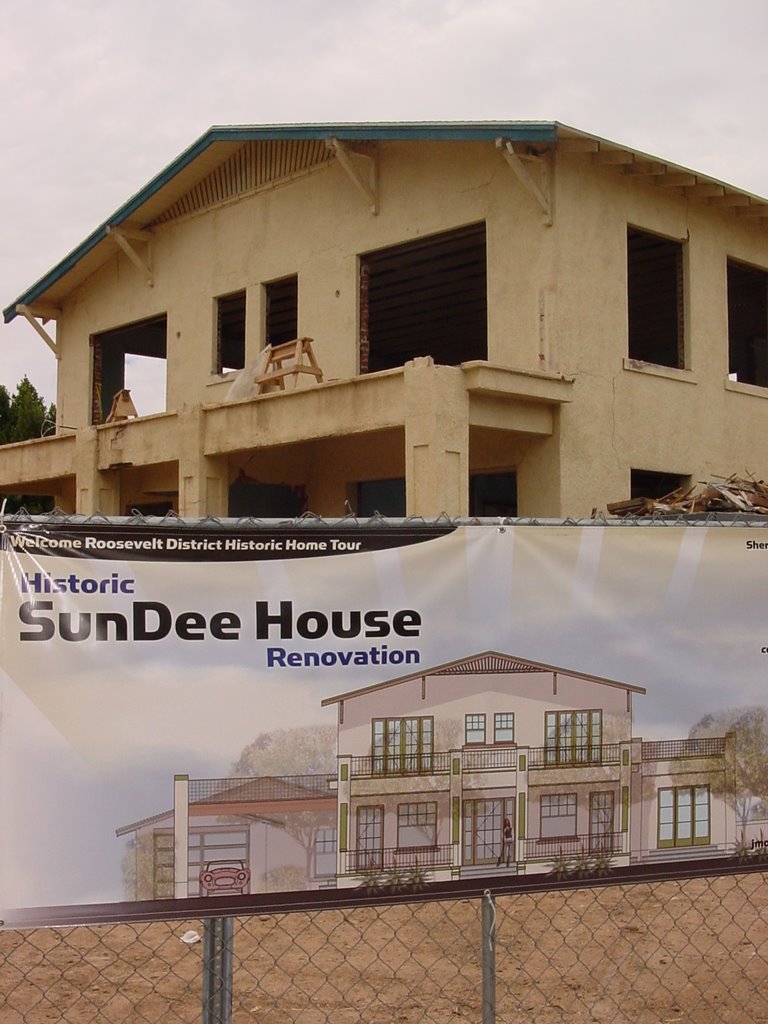
The area centered around 3rd Avenue and Portland Streets continues to emerge as a true, pedestrian-oriented urban environment. Pictured here is the Sun Dee Building, located at the southeast corner of 3rd Avenue and Portland. The building is being renovated by Desert Viking Co. (whose credits include the nearby Gold Spot Market and Lamar Building). The building will be a single family-home supposedly selling for more than $1,000,000. Meanwhile, Desert Viking is moving ahead with plans for a condominium on the northeast corner of the same intersection. The property was fenced off this week and a hearing on a city variance is upcoming.
Monday, October 23, 2006
Central Phoenix still has a football power
While some other central Phoenix high schools have seen their sports programs decline during the past 20-30 years, Brophy still remains a powerhouse. Brophy won its first state football title last season. Congratulations to the Broncos for their big win over archrival St. Mary's last week.
Friday, October 20, 2006
Downtown tidbits
A few musings on downtown Phoenix happenings:
* Portland Place has sold 46 of its 54 condos as of yesterday. Another condo may open up, but this is still encouraging news for the downtown condo market, particularly after the investors jumped ship. The picture here is the rooftop at Portland Place. In the foreground is what will become the pool deck, looking south toward the downtown core.
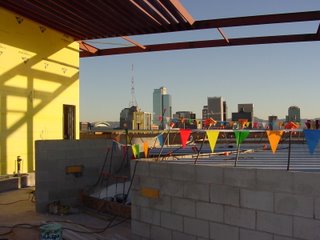
* Weitz may yet be the builder for Portland Place's second phase.
* I brought up a comment that appeared on the forums at skyscraperpage.com, courtesy of the poster Soleri, that construction at Artisan Haus may be delayed or the project may be cancelled altogether, and a Weitz official told me he had "heard the same thing." While I was not a huge fan of the Artisan Haus design, particularly the way the building turned a mostly-blank wall toward Central Avenue, the thought of having another vacant lot in central Phoenix is much less appealing. I hope this project still works out.
* Speaking of vacant parcels on Central, there was some promising news today about the sale of the land at Central and McDowell. Hopefully the entity that purchased the land is serious about developing this parcel across from the Phoenix Art Museum, and isn't simply a speculator. AmLand Development, one of the partners in this resume, has a couple of impressive-looking projects in Philly and in Las Vegas, according to the company's web site. Construction is underway on the Vegas project. How great would it be to have a similar four or five-tower complex built at Central and McDowell?

Tuesday, October 17, 2006
Yes, we have great winter weather. Is that all there is to life in a city?
The Arizona Republic ran its annual piece, coinciding with the first major snowfall back east, in which it basically points out to the locals that 'it's warm here in the winter, and cold in other places!' The added bonus this year was that Buffalo, N.Y. was the metro area that was blasted by snow, so the Republic got to gloat about that area's shrinking population versus the Phoenix area's population explosion.
I lived in Buffalo for two years. Admittedly, it has a lot of problems. But it has a host of assets that Phoenix could only dream of: several major public and private universities, world-class architecture, true urban life in its core (some downtown, most along Elmwood Avenue-- think Central Avenue but with cool shops, restaurants, and people), real neighborhoods, a theatre district, distinct foods and a shared culture. I went to a wedding in Buffalo a couple years back, and at one point several of the guests started chanting "Let's go, Buffalo!" as the DJ played Lloyd Williams' "Shout" (it's played after touchdowns at Buffalo Bills games and featured in the movie Animal House). Try to imagine Phoenicians ever having enough pride in our city to do something like that.
So, while I'm glad that my city is warm in the winter and isn't dwindling away like a few places back east, there's a lot more to life than nice weather. Ignore what the civic cheerleaders at the Arizona Republic would have you think; Phoenix can learn something even from much-maligned (and cold) places like Buffalo.
I lived in Buffalo for two years. Admittedly, it has a lot of problems. But it has a host of assets that Phoenix could only dream of: several major public and private universities, world-class architecture, true urban life in its core (some downtown, most along Elmwood Avenue-- think Central Avenue but with cool shops, restaurants, and people), real neighborhoods, a theatre district, distinct foods and a shared culture. I went to a wedding in Buffalo a couple years back, and at one point several of the guests started chanting "Let's go, Buffalo!" as the DJ played Lloyd Williams' "Shout" (it's played after touchdowns at Buffalo Bills games and featured in the movie Animal House). Try to imagine Phoenicians ever having enough pride in our city to do something like that.
So, while I'm glad that my city is warm in the winter and isn't dwindling away like a few places back east, there's a lot more to life than nice weather. Ignore what the civic cheerleaders at the Arizona Republic would have you think; Phoenix can learn something even from much-maligned (and cold) places like Buffalo.
Wednesday, October 11, 2006
Ghetto?
A recent post on a message board discussing Phoenix referred to downtown Phoenix and environs as "ghetto." I've had a couple visitors to my place insinuate the same thing. Yeah, well, browse this list of recent downtown home sales and try to make that argument. Keep in mind that the median resale price of a home in the Phoenix area is $257,000.
Thursday, October 05, 2006
Gentrification: really an issue?
The latest protest against the "gentrification" of downtown Phoenix is profiled in this week's Phoenix New Times. Basically, some of the artists who helped colonize this area fear a wave of yuppie lofts and chain stores overrunning the neighborhood. I think these fears are a little ridiculous. It's one thing when gentrification of a neighborhood drives lower-income residents out of their homes. But while that happens a lot in other cities, there's not much evidence of that happening in Phoenix.
Here, most of the new condos and lofts are being built on what were previously dirt lots or underutilized properties (as in the case of 44 Monroe, Artisan Village, and Portland Place). No residents are being forced to leave because of the construction, and it doesn't appear as though rising property values have changed the composure of nearby neighborhoods like Garfield. And thus far, the retail that has come with the new developments has been organic, non-chain type fare such as Cheuvront and Tammie Coe/MJ Bread. True, if the new developments bring more standbys like the generic P.F. Changs (as promised by the CityScape development) that would be a bad thing. But there's no worries of downtown Phoenix becoming another chain-infested Mill Avenue yet.
What downtown needs is more residents. Yuppies, artists, families...there's room for everybody. And what is the alternative to the development...downtown Phoenix remains filled with vacant dirt lots?
Here, most of the new condos and lofts are being built on what were previously dirt lots or underutilized properties (as in the case of 44 Monroe, Artisan Village, and Portland Place). No residents are being forced to leave because of the construction, and it doesn't appear as though rising property values have changed the composure of nearby neighborhoods like Garfield. And thus far, the retail that has come with the new developments has been organic, non-chain type fare such as Cheuvront and Tammie Coe/MJ Bread. True, if the new developments bring more standbys like the generic P.F. Changs (as promised by the CityScape development) that would be a bad thing. But there's no worries of downtown Phoenix becoming another chain-infested Mill Avenue yet.
What downtown needs is more residents. Yuppies, artists, families...there's room for everybody. And what is the alternative to the development...downtown Phoenix remains filled with vacant dirt lots?
Sunday, September 17, 2006
Pluses, Minuses
While much of the attention downtown focuses on the "big" issues like ASU Downtown, just as important is what's going on at the "micro" level on the street. There are pluses and minuses here. A minus: Retail Laboratory, a fun (although expensive!) gift boutique on Roosevelt Street, has closed its doors after just a few months to concentrate on its sister store at the Biltmore Fashion Park.
A plus: permit application signs at Canvas (criticized by me just a few weeks ago in this blog) on Third Street and Roosevelt indicate that a restaurant known as the "Gallery Bar and Grill" is in the works, featuring outdoor seating. Looking forward to that.
A plus: permit application signs at Canvas (criticized by me just a few weeks ago in this blog) on Third Street and Roosevelt indicate that a restaurant known as the "Gallery Bar and Grill" is in the works, featuring outdoor seating. Looking forward to that.
Saturday, July 29, 2006
Misplaced Priorities
I hate to pick on anyone from downtown Phoenix's artist community. Without local artists serving as downtown pioneers, there would be no First Fridays and the rejuvenated areas along Roosevelt and Grand Avenue would still be as dead as a doornail.
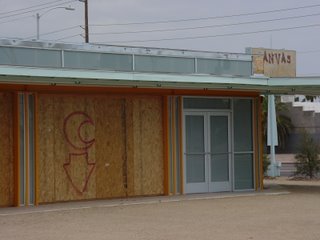
But that doesn't mean they do everything right. Case in point is Canvas, a gallery on Third Street and Roosevelt that comes to life once a month on First Fridays. The owners of this gallery, for some unknown reason, chose to build a parking lot (as if Phoenix needs any more of those) on Roosevelt at about Fourth Street. This forecloses development on a great location on what is probably downtown's most promising street. But it also makes no sense when you look at the Canvas building itself, which is still covered in particle board that has been tagged. From my vantage point, Canvas would have been better served finishing the exterior of the building as opposed to building another unnecessary parking lot.
But that doesn't mean they do everything right. Case in point is Canvas, a gallery on Third Street and Roosevelt that comes to life once a month on First Fridays. The owners of this gallery, for some unknown reason, chose to build a parking lot (as if Phoenix needs any more of those) on Roosevelt at about Fourth Street. This forecloses development on a great location on what is probably downtown's most promising street. But it also makes no sense when you look at the Canvas building itself, which is still covered in particle board that has been tagged. From my vantage point, Canvas would have been better served finishing the exterior of the building as opposed to building another unnecessary parking lot.

Saturday, July 22, 2006
Fillmore 555: Another Roosevelt Development
Here's a rendition of the Fillmore 555 project at 5th Ave. and Fillmore. According to the Roosevelt Action Association, the Phoenix City Council will consider its approval in August or September. The first floor of this project is slated to house retail development, and the city may allow on-street parking (which I sincerely hope it does).
 This information was taken from a City of Phoenix powerpoint presentation focusing on adding retail to downtown Phoenix.
 This information was taken from a City of Phoenix powerpoint presentation focusing on adding retail to downtown Phoenix.
Friday, July 21, 2006
Urban living alive and well
With the real estate downturn, it's hard to say what will become of the fledgling condo/loft market in downtown Phoenix and other urban areas of town, especially in a market that historically is totally single-family housing driven. But last night's open house at Portland Place seems to show that there's still a lot of interest in urban living. The sales center was jammed with buyers from Phase 1 of the project, prospective buyers, and real estate professionals. They even had to valet cars on a nearby dirt lot. And, judging from the upscale food and beverages provided, the builder, Crescent Communities, appears to have some deep pockets to continue to back this project.
Other tidbits: According to Portland Place sales reps, the first phase is not totally sold out (despite what some realtors have believed). In fact, while the permitting process for the 10-story second phase is ongoing, groundbreaking can't occur until the requisite number of sales take place in Phase 1. The sales reps seemed to indicate that they are still short of that figure.
Other tidbits: According to Portland Place sales reps, the first phase is not totally sold out (despite what some realtors have believed). In fact, while the permitting process for the 10-story second phase is ongoing, groundbreaking can't occur until the requisite number of sales take place in Phase 1. The sales reps seemed to indicate that they are still short of that figure.
Sunday, July 16, 2006
Life on the Highway: 7th Street
I had a chance to cruise by the interesting collection of businesses on 7th Street yesterday: Trente Cinq, Drip Coffee and Lisa G Wine Bar. Down the street is mainstay Coronado Cafe. There are quite a few urban destinations along that road, just as there are on 7th Avenue. And a lot of these places are fairly new. But while these are all promising signs of rebirth in Central Phoenix, they can only go so far in creating real city life because for all intents and purposes, they sit on highways. 7th Street and 7th Avenue each are six or seven-lane highways that serve as virtual walls cutting off one side of the street from the other. Pedestrians trying to cross these highways are taking their lives in their own hands.
While Phoenix is putting some money into narrowing 24th Street between McDowell and Washington as part of the recent bond package, it appears nothing will be done to narrow these streets in the immediate future. If Phoenix is really serious about bringing pedestrians to central and downtown Phoenix, a big start (bigger than adding shade, in my opinion) would be to narrow streets like 7th Street and 7th Avenue (and Third Street, and Third Avenue, and so on...) by expanding the sidewalk and even allowing vehicles to park on the street. I know this will never happen, but one can always dream.
While Phoenix is putting some money into narrowing 24th Street between McDowell and Washington as part of the recent bond package, it appears nothing will be done to narrow these streets in the immediate future. If Phoenix is really serious about bringing pedestrians to central and downtown Phoenix, a big start (bigger than adding shade, in my opinion) would be to narrow streets like 7th Street and 7th Avenue (and Third Street, and Third Avenue, and so on...) by expanding the sidewalk and even allowing vehicles to park on the street. I know this will never happen, but one can always dream.
Sunday, July 09, 2006
Phoenix and Scottsdale- culture wars
"Sorry, Scottsdale.
-Phoenix."
This statement, captured on a t-shirt selling at the Red Dog Gallery on 3rd Street during July First Fridays, summed up the current state of affairs in the metro area. Phoenix seems to have aimed for a more serious approach to culture, while Scottsdale is currently epitomized by the Tuesday Night Book Club, plastic surgery, and prominent civic leader Jenna Jameson. And no, Scottsdale, hosting the second location of the Pink Taco Restaurant is not a symbol of sophistication. You wouldn't see something like that in a classy city like Boston or New York...
Hopefully Phoenix never steers toward this path.
-Phoenix."
This statement, captured on a t-shirt selling at the Red Dog Gallery on 3rd Street during July First Fridays, summed up the current state of affairs in the metro area. Phoenix seems to have aimed for a more serious approach to culture, while Scottsdale is currently epitomized by the Tuesday Night Book Club, plastic surgery, and prominent civic leader Jenna Jameson. And no, Scottsdale, hosting the second location of the Pink Taco Restaurant is not a symbol of sophistication. You wouldn't see something like that in a classy city like Boston or New York...
Hopefully Phoenix never steers toward this path.
Shade, shade, shade
The current buzz in downtown Phoenix is about making the area an "oasis of shade." The Downtown Phoenix Urban Form project has made shade a major priority. And the Downtown Voices Coalition has talked about using shade to make downtown more walkable for years.
But I wonder if this concept, while important, isn't being oversold. Yes, downtown Phoenix has a lot of barren, shadeless areas. And certainly, much more should be done to add trees to the sidewalk, for instance, and use building codes to encourage shade from buildings as the Urban Form project plans to do.
But the lack of shade-- and the summer heat-- are not the reasons why people don't mingle in downtown Phoenix or walk much in the area. If they were, Phoenix would come alive with pedestrians in the cooler winter months. It doesn't. People still stay in their cars. So while adding some relief from the summer sun would be a welcome change for downtown Phoenix, that alone won't bring life to downtown. I wonder if it will change things much at all.
But I wonder if this concept, while important, isn't being oversold. Yes, downtown Phoenix has a lot of barren, shadeless areas. And certainly, much more should be done to add trees to the sidewalk, for instance, and use building codes to encourage shade from buildings as the Urban Form project plans to do.
But the lack of shade-- and the summer heat-- are not the reasons why people don't mingle in downtown Phoenix or walk much in the area. If they were, Phoenix would come alive with pedestrians in the cooler winter months. It doesn't. People still stay in their cars. So while adding some relief from the summer sun would be a welcome change for downtown Phoenix, that alone won't bring life to downtown. I wonder if it will change things much at all.
Sunday, July 02, 2006
A Downtown Phoenix Partnership idea that actually makes sense for downtown?
The Downtown Phoenix Partnership recently hired a consultant that recommended raising parking rates in downtown and suggested there will be a need for 27,000 additional parking spaces downtown in the next decade. And while complete details have yet to emerge, it seems possible that DPP might actually 'get it' this time.
At first, the idea that downtown could actually need any more parking seems ludicruous when the Garage Mahal is losing $3M annually and it's been reported that downtown already has as many as 50,000 parking spaces. The fact that parking in downtown Philadelphia, for instance, is eight times as expensive as here also suggests that the supply of parking is dramatically overbuilt.
Still, my overriding objection to the glut of parking downtown is the manner in which garages here have been built. Generally parking structures in Phoenix are stand-alone, space-killing buildings that in some cases occupy entire city blocks. Most have no street retail and deaden the surrounding areas. Not to mention they're just butt-ugly.
But the DPP plan actually seems to understand all this, and, perhaps with the urging of Phoenix officials, claims to make "a priority to build mixed-use, pedestrian-friendly streetscapes and buildings. " This includes underground parking.
So, while I continue to question the need for all the additional parking given what exists now and the fact that light rail is on the way, at least it may be that we've seen the last of the construction of the Soviet-style parking garages that currently dominate downtown.
At first, the idea that downtown could actually need any more parking seems ludicruous when the Garage Mahal is losing $3M annually and it's been reported that downtown already has as many as 50,000 parking spaces. The fact that parking in downtown Philadelphia, for instance, is eight times as expensive as here also suggests that the supply of parking is dramatically overbuilt.
Still, my overriding objection to the glut of parking downtown is the manner in which garages here have been built. Generally parking structures in Phoenix are stand-alone, space-killing buildings that in some cases occupy entire city blocks. Most have no street retail and deaden the surrounding areas. Not to mention they're just butt-ugly.
But the DPP plan actually seems to understand all this, and, perhaps with the urging of Phoenix officials, claims to make "a priority to build mixed-use, pedestrian-friendly streetscapes and buildings. " This includes underground parking.
So, while I continue to question the need for all the additional parking given what exists now and the fact that light rail is on the way, at least it may be that we've seen the last of the construction of the Soviet-style parking garages that currently dominate downtown.
Subscribe to:
Posts (Atom)